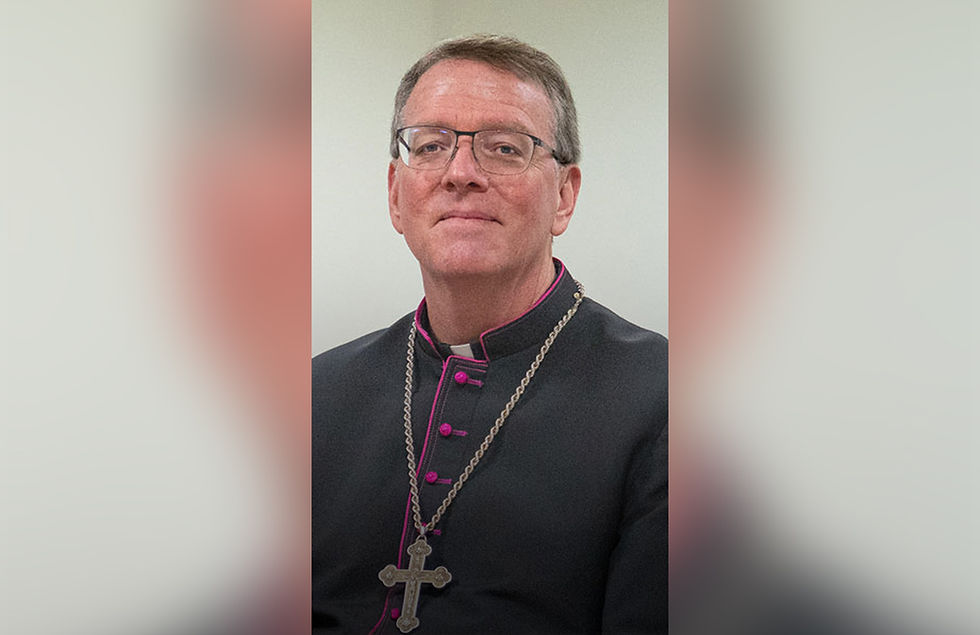
"A Seedling of Faith": Bishop-Elect Anthony Corcoran, SJ, on the Catholic Church in Kyrgyzstan Today

Following the announcement of his appointment as Bishop by Pope Leo XIV, we share this interview with Fr. Anthony Corcoran, SJ, in which he reflects on the life, challenges, and vision of the Catholic community in the Kyrgyz Republic.

What is the profile of the Catholic Church in Kyrgyzstan today?
Pope Francis referred to the Church in Central Asia as germoglio — a seedling. Indeed, the Catholic community in this country is very small. We estimate that there are currently only a few hundred Catholics living in Kyrgyzstan. Despite the fact that the number of Catholics here and throughout Central Asia has significantly decreased over the past decades as a result of emigration, the Church is very much alive. The little communities are centers of faith, social, and cultural activity.
The active presence of the Catholic Church is in itself a reality that can be viewed with the conviction of hope and the realization that the need for this presence exists in each society. The Church here continues to exercise an influence that can be understood as exceeding the size of the little community. Social, academic, cultural, and religious engagement make the activity, values, and goals of the Church known to many throughout the country.
What are the particular challenges facing the Catholic Church in Kyrgyzstan today?
I think it is fair to say that the small size of the Catholic community renders us somewhat "vulnerable."
In addition to the significant decline in the number of Catholics due to ongoing emigration, other difficulties are caused by various social factors. Religion in this region is inextricably linked with ethnic identity. Asian populations are generally presumed to be Muslim; Russians to be Orthodox; Poles and Germans to be Catholic or Protestant. Conversion to a religion other than the one associated with your ethnic group is usually met with disapproval, sometimes even with hostility. Evangelization in such a context is especially delicate, and converts can experience significant negative consequences.
A simultaneous emergence of secularization has also impacted some of the population. Furthermore, Catholicism has commonly been portrayed as a western religion and, consequently, associated with more liberal values and trends — an association that heightens suspicion in parts of this society.
Why would there be a need for a Catholic Bishop in Kyrgyzstan?
The Church always strives to maintain an integrity in the support and structure of local Churches, regardless of their size. If the Catholic Church in Kyrgyzstan is one of the smallest in the world, it is still a part of the universal Catholic Church and is led by a shepherd appointed by the Pope.
My understanding is that Pope Leo XIV's decision to elevate me to the episcopacy affirms this conviction. An Apostolic Administration is designed as a structure where many of the essential elements necessary to comprise a diocese are still lacking — in terms of number of faithful, financial independence, and personnel resources. But having an ordained bishop strengthens this local Church in ways both visible and spiritual, particularly in the service of the larger Church's goals within our region.
Will your work change with ordination to the episcopacy?
The primary service remains to shepherd the Catholic community in this country and to represent the Church in a visible way before society. The "grace of office" and the authority entailed in the episcopate, for believers, is significant.
I can affirm that I am called increasingly to give all — to be "all in" — with regard to my vocation to give myself to the needs of this community.
What is the profile of the majority Muslim religion in Kyrgyzstan?
Many, if not most, Muslim citizens are moderate. Members of the older generation were influenced by the Soviet Union's persistent endeavor to secularize its citizens during the more than seven decades of rule. Many Kyrgyz have returned to practicing Islam over the past thirty years, and our relationship with the Muslim community is generally quite positive.
Unfortunately, there is a smaller yet growing presence of a more radical form of Islam, mostly imported through foreign activities or brought home by workers or students who have lived or studied abroad. This phenomenon could prove increasingly threatening to society and tests the government's long-standing commitment to permit freedom of religious practice.
Catholics and members of other minority religious groups will likely find themselves in an increasingly vulnerable position. It remains unclear what effect government steps to curb extremist religious activity will have on the Church's ability to continue to operate unhindered.
Is there something in the Church's approach to society and evangelization that could be renewed or shifted?
Pastoral service to Catholics — and endeavoring to encourage within our faithful the desire to become a community more deeply rooted in Kyrgyz culture — remains an essential task. For too long, priests and others in the Church have had an inward-looking view, perceiving their primary role as serving as chaplains to peoples belonging to traditionally Catholic ethnic groups. This perception does not sufficiently embrace the vision or needs of today's community, nor is it consistent with our mandate to look up and outward in sharing the Good News.
The need to affirm the Church's commitment to contribute in a meaningful way to the building up of this country — to the promotion of the common good — is especially important at this time.
What are the essential aspects of the apostolic plan of the local Church?
Our priorities include:
Reanimating the mission in the south, where the Church has entrusted the Polish Province of the Society of Jesus with the strengthening of the parish in Osh, the second largest city in Kyrgyzstan.
Building the Good Shepherd Cathedral and Apostolic Center in Bishkek — a project of hope and light for the Catholic Church in Kyrgyzstan, currently in the second of four phases of construction.
Making the Church more authentically Kyrgyz — including a deeper commitment to the Kyrgyz language among our priests and missionaries. Without more focused effort in this area, the Catholic community will seem alien to the next generation of primarily Kyrgyz-speaking members.
Witness through charity, culture, and education — including our kindergarten and early childhood center, rehabilitation programs at Lake Issyk-Kul, support for children with special needs, academic assistance for families of limited resources, and emergency relief.
Ad Majorem Dei Gloriam.
*All articles in our blog are written with the help of Claude AI and reviewed by human editors.